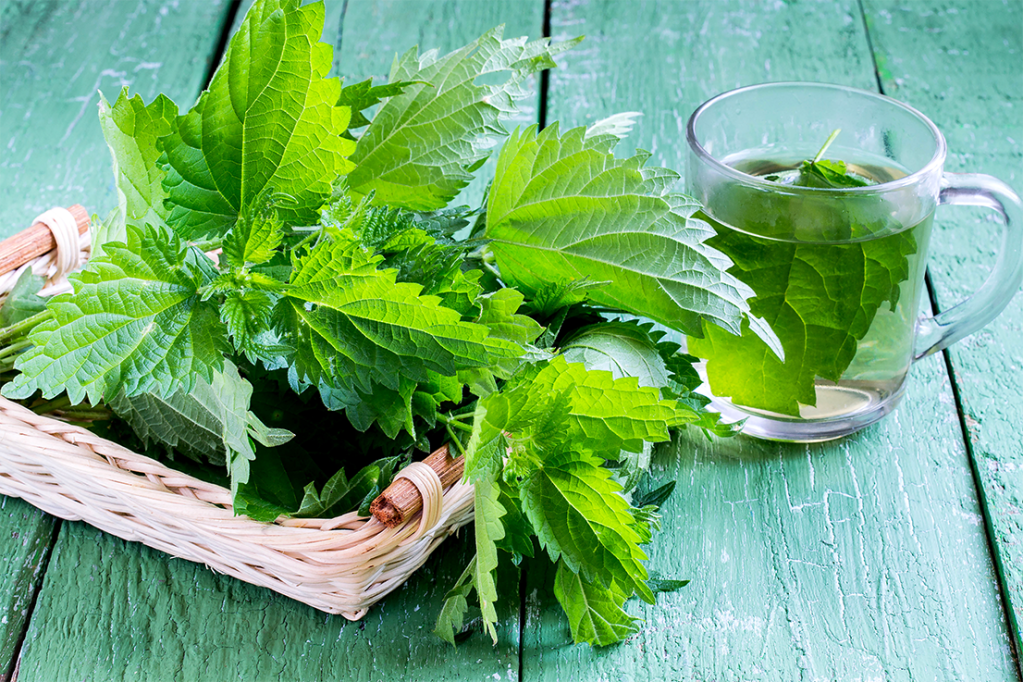
🌿 Stinging Nettle
Urtica dioica
Family:
Urticaceae — Nettle Family
Part Used:
Leaf · Young aerial parts
Character:
Green · Mineral-rich · Nourishing · Restorative
There are plants that invite us closer.
Nettle makes us earn the introduction.
Covered in tiny stinging hairs,
she protects herself remarkably well for a plant that has spent centuries feeding,
clothing,
and supporting the people willing to learn how to approach her.
Once dried,
cooked,
or properly prepared,
the sting is gone.
What remains is one of the garden’s great nourishing plants.
🌱 The Plant
Stinging Nettle is a perennial herb that favors rich,
moist ground
and often appears near streams,
woodland edges,
disturbed soils,
gardens,
and places where people have lived.
Its leaves grow opposite one another along the stem,
with deeply toothed edges and a pointed shape.
And then there are the hairs.
Touch fresh nettle carelessly and you’ll understand immediately how it got its name. 😂
Those tiny hollow hairs act almost like miniature needles,
delivering irritating compounds into the skin when they’re disturbed.
Nettle doesn’t hide its boundary.
It teaches you where it is.
🌿 In the Herbal Tradition
Nettle leaf has a long history as both food and herb.
Young leaves have traditionally been cooked and eaten as spring greens, while dried nettle is commonly prepared as tea or a longer infusion.
Nettle is especially valued as a nutritive herb. Its leaves contain minerals and other plant nutrients, which is one reason it has found such a natural home in the everyday herbal cupboard.
At 5K, I don’t think of Nettle as a plant that needs to shout.
It is a plant of replenishment.
Something gathered from the earth and returned to the body slowly.
🫙 The Long Infusion
Nettle is particularly well suited to a longer infusion.
Rather than dipping a tea bag into hot water for a few minutes, a generous amount of dried herb can be allowed to remain in water for hours.
Time changes the conversation.
The resulting infusion becomes darker, greener, and much more substantial than an ordinary cup of tea.
Nettle is one of the foundation herbs in Steady Ground, where I combine it with oatstraw, marshmallow root, and a small amount of peppermint and allow the blend to extract slowly in cool water.
🌿 Visit Steady Ground
🥬 From Herb to Food
Nettle also sits in that lovely place where the Herbarium meets the Mountain Kitchen.
Young leaves can be cooked much like other leafy greens and have traditionally found their way into soups, sauces, fillings, and other foods.
Never eat mature raw stinging nettle straight from the plant.
Cooking, drying, crushing, or otherwise properly processing the leaves disables the sting.
One day, I suspect Nettle will wander into the 🍲 Mountain Kitchen too.
🌱 Meeting Nettle in the Wild
If you’re gathering Nettle yourself, identification matters.
Wear gloves and use scissors rather than pulling at the plant.
And perhaps tuck those familiar things into your trail pack:
Brown paper bags.
Sharpie.
Scissors.
Harvest only where gathering is permitted, away from contaminated roadsides or sprayed areas, and take only what the stand can comfortably spare.
Nettle has already made her position on careless handling quite clear. 😂
💎 Stone Companion
Garnet
I actually like Garnet beside Nettle.
Not because the two are equivalent, but because they share something in their character:
Nettle protects what it contains.
Garnet holds its strength within.
One guards itself with a sting.
The other carries its depth quietly beneath the surface.
🩷 Meet Garnet in The Heart
🌿 A Keeper’s Note
🌿 A Keeper’s Note
I have always had a soft spot for Stinging Nettle.
I grew little nettle plants in my flower box, and despite their reputation, I never thought of them as fierce.
They were fluffy. And cute.
When the wind came through, they would dance for me.
In the mornings, the Steller’s jays would arrive and hop around the flower bed looking for seeds, weaving their way through my favorite fluffy plants.
It made me happy just to watch them.
Perhaps that is why I have never thought the sting tells the whole story of Nettle.
A plant can protect itself and still be soft.
It can have very clear boundaries and still dance when the wind comes through.
A boundary doesn’t necessarily mean go away.
Sometimes it means learn how to approach me.
Continue to 🌿 The Herbarium
Visit 🌿 Steady Ground
Explore 🩷 The Heart
Return to 🌿 Welcome Home
 5K High Altitude Apothecary