💡What Did They Notice?
Hair as Teacher
Hair is such an ordinary part of being human that we rarely
stop to wonder why people have paid so much attention to it.
And yet,
across cultures and across thousands of years,
people have grown it,
shaved it,
braided it,
bound it,
covered it,
shaped it,
offered it,
mourned through it
and even consulted the Moon before cutting it.
Why?
What did they notice?
Hair and Power
One of the oldest stories many of us know is Samson.
His uncut hair was part of his sacred vow.
When it was cut,
his extraordinary strength left him.
Far to the north,
another story tells of Sif and her beautiful hair.
Loki cut it from her head while she slept.
The act was serious enough that Thor demanded it be made right,
and Loki eventually brought Sif something extraordinary:
hair fashioned from threads of gold,
made by the dwarfs,
which would grow upon her head like living hair.
Two very different traditions.
Two stories in which cutting someone’s hair is anything but insignificant.
Hair and the Sacred
Then there are traditions
that seem to turn the idea completely around.
Buddhist monks and nuns shave their heads as part of
leaving behind attachment to appearance,
status and the identity of ordinary worldly life.
Ancient Egyptian priests also shaved their heads
and even their bodies
as part of ritual purification before serving in the temple.
And yet Egyptians created elaborate wigs.
Sometimes the natural hair was removed
only for hair to return in another form.
That fascinates me.
Perhaps the importance of hair isn’t always expressed by preserving it.
Sometimes its significance is demonstrated by deliberately removing it.
Hair Kept
Sikh tradition gives us almost the opposite practice.
Kesh
uncut hair
is one of the articles of faith.
The hair is allowed to remain as it was given,
carefully tended
and usually gathered
and protected rather than simply left loose.
In many Orthodox Jewish communities,
a married woman’s natural hair is covered.
Depending upon the community,
she may cover it with a scarf,
hat or even another head of hair
a wig.
Again,
the hair has not become unimportant.
Quite the opposite.
Something about it has become private.
Hair Shaped
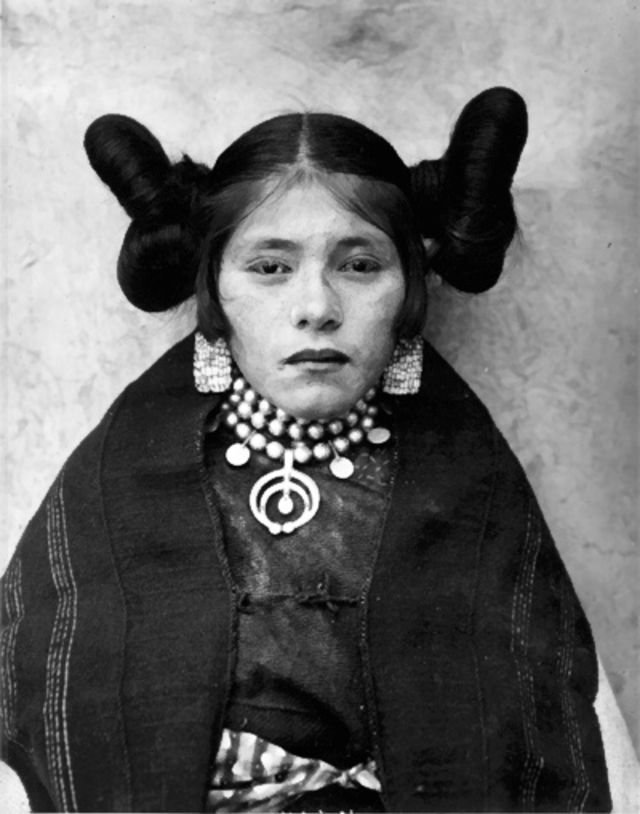
And then I found myself looking at photographs of Hopi maidens.
Their hair was arranged into enormous whorls on either side of the head.
From the front,
they are extraordinary.
When several young women stand together,
it can appear as though there are butterflies behind their heads.
The hairstyle belongs to the maana stage of a young woman’s life
and has been described through both butterfly
and squash-blossom imagery.
It marks a transition.
Hair has become language.
It tells the community something about the one wearing it
without her having to say a word.
Hair and Connection
Years ago,
I encountered another teaching that stayed with me:
Hair is antenna.
I was taught that hair could have something to do with perception
with our ability to receive information from the world around us.
I have also encountered Native teachings in which hair is connected with
ancestry,
identity,
vitality
and spiritual relationship.
I don’t know that these teachings are all describing the same phenomenon.
And I certainly wouldn’t assign the antenna teaching
to the Hopi simply because their hairstyle reminds me of it.
But it does make me wonder.
If hair has been understood as part of our connection
to something beyond ourselves,
what happens when we change its state?
Loose.
Braided.
Bound.
This may be one of the questions that interests me most.
Hair can hang freely.
It can be braided.
Twisted.
Bound.
Covered.
Cut.
Shaved completely away.
And many cultures have cared very much which of those things was done.
A braid gathers thousands of individual strands and makes them one.
Loose hair allows every strand to move independently.
Whether that changes anything beyond the physical,
I don’t know.
But as an image,
it is beautiful:
one gathers;
one reaches.
Perhaps that is why I keep returning to the question.
Even the Moon
And then there is something stranger still.
For generations,
people have timed the cutting
and care of hair according to the Moon.
In various folk and astrological traditions,
the Moon has been consulted when deciding when to trim,
cut or otherwise tend the hair.
Some systems become remarkably specific,
considering not only the lunar phase
but the astrological sign through which the Moon is moving.
I remember discovering this while studying the Moon and being astonished by it.
Because now the question wasn’t simply whether hair should be long or short.
Or loose or braided.
Or covered or uncovered.
It was:
When should it be touched?
What Did They Notice?
Perhaps all of these traditions arose independently
for entirely different reasons.
They certainly don’t all teach the same thing.
But I find the repetition difficult to ignore.
Again and again,
human beings have taken this strange substance growing from our heads
and given meaning to what we do with it.
We have used hair to signify childhood and adulthood.
Marriage and mourning.
Beauty and humility.
Sacred vows and religious devotion.
Identity and surrender of identity.
Power.
Purity.
Ancestry.
Belonging.
Rebirth.
And sometimes,
perhaps,
connection.
I don’t need to make all of those traditions say the same thing.
I would rather leave room for the mystery.
Because whenever many different people,
separated by geography,
language,
religion and time,
keep turning their attention toward the same ordinary thing,
I become curious.
Maybe the question isn’t:
What does hair mean?
Maybe the better question is the one that started this whole journey.
What did they notice?
Life is always teaching.
Sometimes the lesson has been growing from our own heads all along.

