

👅 A Tongue, a King & an Ancient Tibetan Hello
Sometimes curiosity begins in very serious places.
And sometimes it begins with a gorilla sticking his tongue out.
I came across a photograph of a magnificent silverback sitting in the grass, tongue extended, looking entirely pleased with himself.
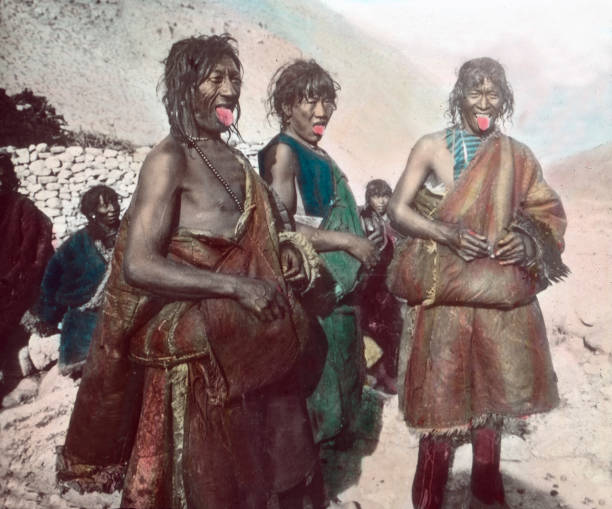
It reminded me of something I had seen before: the Tibetan custom of showing the tongue in greeting.
So, naturally, I went looking.
A Greeting That Isn’t Quite What It Seems
Sticking out one’s tongue is not a Buddhist greeting in general.
It is specifically associated with traditional Tibetan culture, where showing the tongue has been used as a gesture of greeting, respect, and peaceful intention.
To Western eyes, of course, this is rather wonderful.
We are generally taught that sticking your tongue out at someone is rude, childish, or teasing.
In Tibet, the same little piece of human anatomy acquired an entirely different language.
And one traditional story explaining why goes back more than a thousand years.
The King With the Black Tongue
According to Tibetan tradition, a ninth-century king named Langdarma became infamous for his persecution of Buddhism.
Legend eventually gave him another distinguishing characteristic:
a black tongue.
After Langdarma’s death, a story developed that Tibetans would show one another
their tongues to demonstrate that theirs was not black—and therefore that they were
not the wicked king returned in another life.
Imagine that greeting:
Hello.
Hello.
👅
Excellent.
Not the evil king.
Carry on.
There is something wonderfully human about it.
History, Legend & the Stories We Keep
There is an important distinction, though.
The story of Langdarma’s black tongue belongs partly to folklore and traditional explanation.
We cannot say with certainty that fear of his reincarnation actually created the Tibetan custom.
The gesture may be older, and Tibetan etiquette has included showing the tongue as an expression of humility or respect in other contexts.
That makes the story more interesting to me, not less.
Because customs often work that way.
A gesture begins.
Generations repeat it.
Stories gather around it.
Eventually history, symbolism, memory, humor, fear, and tradition become woven together so tightly that separating them may be less interesting than asking:
What did the gesture come to mean?
In this case, an exposed tongue could communicate something remarkably gentle:
I mean you no harm.
I approach you respectfully.
There is nothing hidden here.
One Gesture, Entirely Different Worlds
I love reminders like this because they expose something we easily forget:
A gesture does not carry meaning by itself.
We give it meaning.
A tongue extended in one culture may be an insult.
Somewhere else, it may be respect.
A bow may be greeting, reverence, apology, or gratitude.
An object may be ordinary until someone gives it significance.
A stone may simply be a stone—
until someone sees a city, a turkey, a waterfall, a sleeping angel, or Atlantis burning inside it.
Perhaps this is one of the quieter ways we remember that the world is larger than the meanings we were handed.
There are always other ways of seeing.
And occasionally, something as ridiculous as a gorilla sticking out his tongue is enough to remind us.
👅 Welcome, stranger.
I mean you no harm.
Continue Exploring…
Continue to 💌 Greeting Cards
Read more about 🦊 Fellow Travelers
Return to 📖 The Mountain Journal
 5K High Altitude Apothecary