🤍 Marshmallow
Althaea officinalis
Family:
Malvaceae — Mallow Family
Parts Traditionally Used:
Root · Leaf · Flower
Character: Cooling · Moistening · Softening
Meet Marshmallow
Marshmallow is an herb of softness.
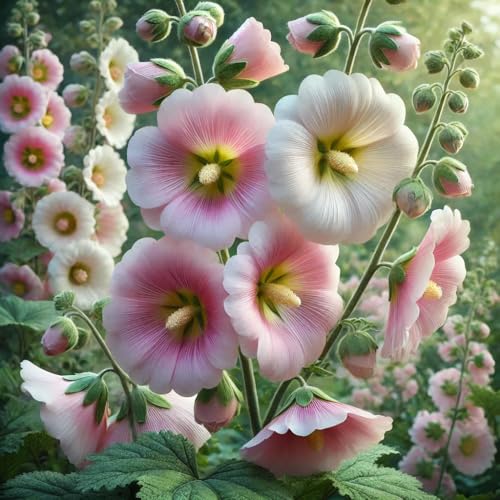
Its pale flowers and velvety leaves give us a hint of what is hidden within the plant.
Most notably in the root.
Marshmallow contains abundant mucilage.
Plant compounds that become slippery and gel-like when combined with water.
That simple botanical characteristic explains much of Marshmallow’s long relationship
with traditional herbalism.
Where tissues feel
dry
irritated
or rubbed raw
Marshmallow has traditionally been chosen to
moisten
soothe
and protect.
It does not arrive with much fanfare.
It coats.
It cushions.
It softens.
Sometimes that is exactly what is needed.
🌿 Traditional Uses
Marshmallow has a long history of use for soothing dry or irritated tissues.
Particularly those of the
digestive
respiratory
and urinary systems.
Traditional herbal preparations have included Marshmallow for:
dry,
irritated throats and coughs
irritated digestive tissues
occasional heartburn or digestive discomfort
urinary-tract irritation
dry or irritated skin
general tissue soothing and moistening
Its usefulness is closely connected to its mucilage
rather than to a stimulating or strongly aromatic action.
This makes Marshmallow quite different from many of the herbs we think of as
“medicine.”
Sometimes its gift is simply providing a protective layer
while the body does its own work.
🤍 The Root
The root is the part most associated with Marshmallow’s famous slippery texture.
When placed in cool water
the dried root gradually releases its mucilage and the water becomes noticeably
thicker and silkier.
For that reason
Marshmallow Root is particularly well suited to a cold infusion.
Cold Infusion
Place dried Marshmallow Root in cool or room-temperature water
allow it to steep for several hours or overnight.
Strain before drinking.
Hot water can certainly extract constituents from Marshmallow
but a long cool infusion is traditionally favored when the goal is that wonderfully
slippery mucilage.
🌱 The Leaf
Marshmallow Leaf is also soothing and mucilaginous
although generally less intensely so than the root.
Traditionally,
the leaf has appeared in teas and herbal blends
intended to support dry or irritated respiratory tissues.
The leaves themselves are wonderfully soft
almost as though the plant is demonstrating its nature before we ever prepare it.
🌸 The Flower
Marshmallow produces delicate pale pink-to-white flowers with darker centers.
The flowers are edible and have also appeared in traditional preparations
although modern herbalists generally work much more frequently with
the root and leaf.
They are worth noticing nevertheless.
The entire plant carries the language of softness.
💧 Marshmallow & Water
Marshmallow is one of my favorite examples of why
preparation method matters in herbalism.
The same plant placed in
alcohol
hot water
or cold water
does not necessarily give us the same preparation.
If what we want from Marshmallow is its abundant mucilage
water is essential
and cool water gives us a particularly beautiful extraction.
This is part of learning an herb:
We do not simply ask what a plant contains.
We ask how the plant gives it to us.
🏔️ Marshmallow at Altitude
At 5,000 feet, dryness is part of the environment.
The air readily takes moisture from skin
lips
nasal passages
and other exposed tissues.
That makes moistening plants particularly interesting companions
in an altitude focused Herbarium.
Marshmallow doesn’t create hydration from nothing.
Rather
its mucilage gives it the remarkable ability to
hold water and create a soothing
slippery preparation.
For 5K High Altitude Apothecary
that makes Marshmallow an especially important plant to know.
🌿 In the Garden
Marshmallow is a perennial herb that appreciates moisture and
traditionally grows in damp meadows,
marsh edges and other relatively wet ground.
It can grow several feet tall,
producing softly textured leaves and delicate flowers during the growing season.
Its botanical name,
Althaea,
comes through Greek and has long been associated with healing
an appropriate history for a plant humans have worked with for centuries.
🍬 And Yes… Marshmallows
The confection really does have a botanical ancestor.
Early versions of marshmallow sweets incorporated preparations
made from Marshmallow Root.
Over time,
confectioners replaced the plant’s mucilage with ingredients such as
gelatin and other modern thickeners.
So the marshmallow roasting over the campfire
and the Marshmallow growing in the Herbarium are distant relatives after all.
The plant came first. 🤍
A Gentle Consideration
Because Marshmallow’s mucilage can coat the digestive tract,
it may affect the absorption of medications taken at the same time.
For that reason,
medications and Marshmallow preparations are generally best
separated rather than taken together.
Anyone using prescription medication,
pregnant or nursing,
or managing a medical condition should check with
an appropriate healthcare professional before using medicinal amounts of an herb.
Marshmallow does not ask the body to push harder.
It offers somewhere soft to land.
See also 🩷 Rose Quartz
Softness is also a form of protection.
Continue Wandering…
Continue to 🫙 Mountain Infusions
Continue to 🌿 The Herbarium
 5K High Altitude Apothecary